Understanding the $250,000/$500,000 Home Sale Tax Exclusion
Learn how the $250,000/$500,000 home sale tax exclusion works, who qualifies, and what happens when your profit exceeds the IRS exclusion limits.
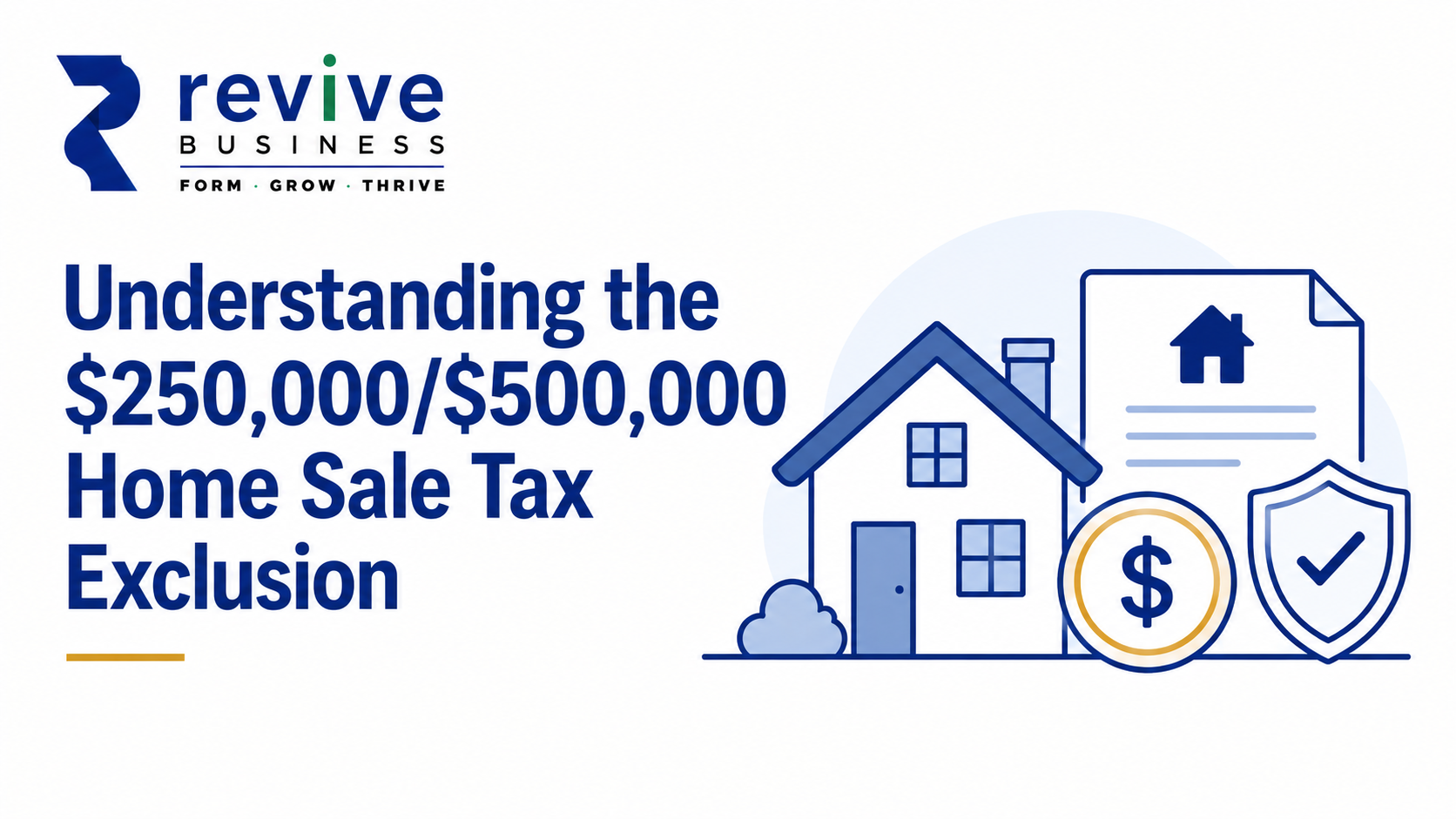
When you are planning on selling your property, you may be asking yourself whether you need to pay any taxes on the sale. This is a reasonable question to have, especially when you have seen an increase in value in your home since its purchase. In some cases, the IRS will allow you to take an exemption of up to $250,000 for single filers or $500,000 for qualified married filers.
What Is the $250,000/$500,000 Home Sale Tax Exclusion?
This exclusion, formally called the Section 121 exclusion, allows homeowners to exclude a portion of the profit gained from the sale of their homes from capital gains taxes.
Basic Limits on the Exclusion
Here's the easy breakdown:
-
$250,000 of gain may be excluded by individuals.
-
$500,000 of gain may be excluded for married individuals who file joint tax returns.
The exclusion applies to your gain, not the total amount for which you sell your home. Your gain generally reflects the difference between the selling price and your adjusted basis, which may be affected by qualifying improvements and certain selling expenses. For example, buying a home for $300,000 and selling it for $500,000 does not necessarily mean your taxable gain is simply $200,000, because other adjustments may apply.
Who Actually Qualifies?
The Ownership and Use Tests
The criteria include the following:
-
You should have owned the property for at least two of the past five years.
-
You should have used the property as your main residence for at least two of the past five years.
One thing you may not know is that the two years you need to spend in the house don't have to be consecutive. You can leave and then return, but as long as you fulfill the two-year requirement in five years, you qualify.
Special Requirements for Married Couples
When it comes to joint filers, there are some extra rules that must be met to qualify for the $500,000 exclusion. As usual, it is necessary that both individuals satisfy the two-year use rule, which means they should have lived in the house as their principal residence during that time. One of them, however, would usually suffice in satisfying the ownership rule.
Such a requirement may be particularly significant for newlyweds, stepfamilies, or spouses who previously owned different principal residences. Marriage itself does not guarantee eligibility for the $500,000 exclusion.
How Often Can You Use This Exclusion?
Normally, however, you may take advantage of this exclusion only once every two years. If you have sold a property within the last couple of years and taken this exclusion into account, it would be prudent to verify whether you will qualify to use this exclusion again. There are several exceptions that we shall soon discuss.
What If Your Profit Is Bigger Than the Exclusion?
This is where confusion sets in: just because you exceed the threshold does not automatically disqualify you from the exemption. You will only forfeit the benefit on the amount that exceeds the limit.
For example, let’s say you’re a single person who gets a $300,000 gain on selling your house. You’ll still be able to claim an exclusion on the $250,000 portion. This will leave you with $50,000 that could possibly be taxed on capital gains, depending on your circumstances.
How Much Tax Could You Owe?
Tax due on any remaining gain will be influenced by the amount of taxable income and filing status, among other things. On any gain on assets that have been owned for over one year, long-term capital gains rates will apply. Federal long-term capital gains rates range between 0%, 15%, or 20% depending on income and filing status.
In effect, it is wrong to assume that a $50,000 gain is taxable at either 15% or 20%. Depending on the taxpayer’s income, the gain may be entirely exempt from tax under the 0% rate, or part of the gain could be taxed at the 15% or 20% rates. High-income taxpayers might also need to factor in the 3.8% Net Investment Income Tax.
Why More Homeowners Are Bumping Into This Problem
The problem is, the exclusions of $250,000 and $500,000 have remained constant for many years now. On the contrary, real estate prices have seen significant growth in many markets.
If you purchased your home 15 or 20 years ago in an environment that witnessed a rise in price levels, you could be holding a large equity that you may not even be aware of. It would indeed mean a big boost to your net worth. However, it could also mean that your profit at the end of the day may be much closer to (or beyond) the exclusion limit than what you had anticipated.
A Commonly Missed Issue: Home Office Depreciation
Taxpayers who have deducted depreciation in respect of business use of a portion of their home will find that they have another potential tax consequence on sale. The depreciation that was claimed in respect of qualifying business use will not necessarily be sheltered under the provisions of Section 121 and could give rise to depreciation recapture. This gain could potentially be taxed at up to 25%.
This is the situation where the homeowner would be eligible for the home sale exclusion but still liable for some tax because of the depreciation taken in prior years. Taxpayers who have claimed home office depreciation should examine their tax position in connection with the sale.
Can You Get a Partial Exclusion?
Even though you do not meet the requirements of ownership and/or use for two years, you can qualify for a partial exclusion under certain conditions. The IRS understands that sometimes people are forced to sell their house before meeting the required period.
-
Moving for work.
-
Moving for health reasons.
-
Certain other unforeseen circumstances.
The size of the partial exclusion typically varies according to the period of time that the property was occupied as your principal residence before selling it and the nature of the sale. Since the computation will directly determine the amount of taxable gain, the partial exclusion should be computed on the basis of these factors.
What About an Inherited Property?
There is an entirely different calculation in the case of inherited property. Normally, a step-up basis applies to inherited property where the property is valued at its fair market value on the day of the owner's death.
For instance, if a property cost the buyer $150,000, but the value of the property increased to $600,000 when the buyer passed away, then an heir could be entitled to a basis of about $600,000. This means that if the heir sells the property for the same price, there would be little or no taxable gain because of the increase in value that happened while the previous owner was alive.
Getting Ready to Report the Sale
Before tax season, it would be good to ensure that all the relevant documents are available. Some of these include:
-
The purchase price of the property.
-
Details on improvements made to the property over time.
-
Details of any depreciation claimed for business or home office use.
-
Selling expenses, such as certain agent commissions and transaction costs.
-
Closing documents.
These documents will assist in the determination of your adjusted basis as well as how much of your gain is eligible for exclusion or is taxable. In cases involving significant gain, inherited property, depreciation recapture, or business use of the home, our tax return filing services can help ensure every figure is calculated correctly before you file.
FAQs About the Home Sale Tax Exclusion
Do I have to pay capital gains tax when I sell my primary home?
Not necessarily. If you meet the ownership and use requirements, you can exclude up to $250,000 (or $500,000 if married filing jointly) of your gain from taxes.
What capital gains tax rate applies to my taxable gain?
The federal long-term capital gains rate generally depends on your taxable income and may be 0%, 15%, or 20%.
Do I need to live in the home for two consecutive years?
No. The two years just need to add up within the five years before the sale — they don't have to be in a row.
Can married couples always claim the $500,000 exclusion?
No. Both spouses generally must meet the use requirement, while only one spouse generally needs to meet the ownership requirement.
What happens if I claim home office depreciation?
Certain depreciation may be subject to depreciation recapture and may remain taxable even if the rest of the gain qualifies for the Section 121 exclusion.
What if my profit is more than $250,000 or $500,000?
Only the amount above your exclusion limit is potentially taxable. The rest still gets the benefit.
Can I claim this exclusion more than once?
Generally, yes, but not more than once every two years, with some exceptions for special circumstances.