Can You Have Multiple Businesses Under One LLC?
Learn how to run multiple businesses under one LLC in 2026 using DBAs or Series LLCs. Evaluate liability risks, tax impacts, and business structuring options.
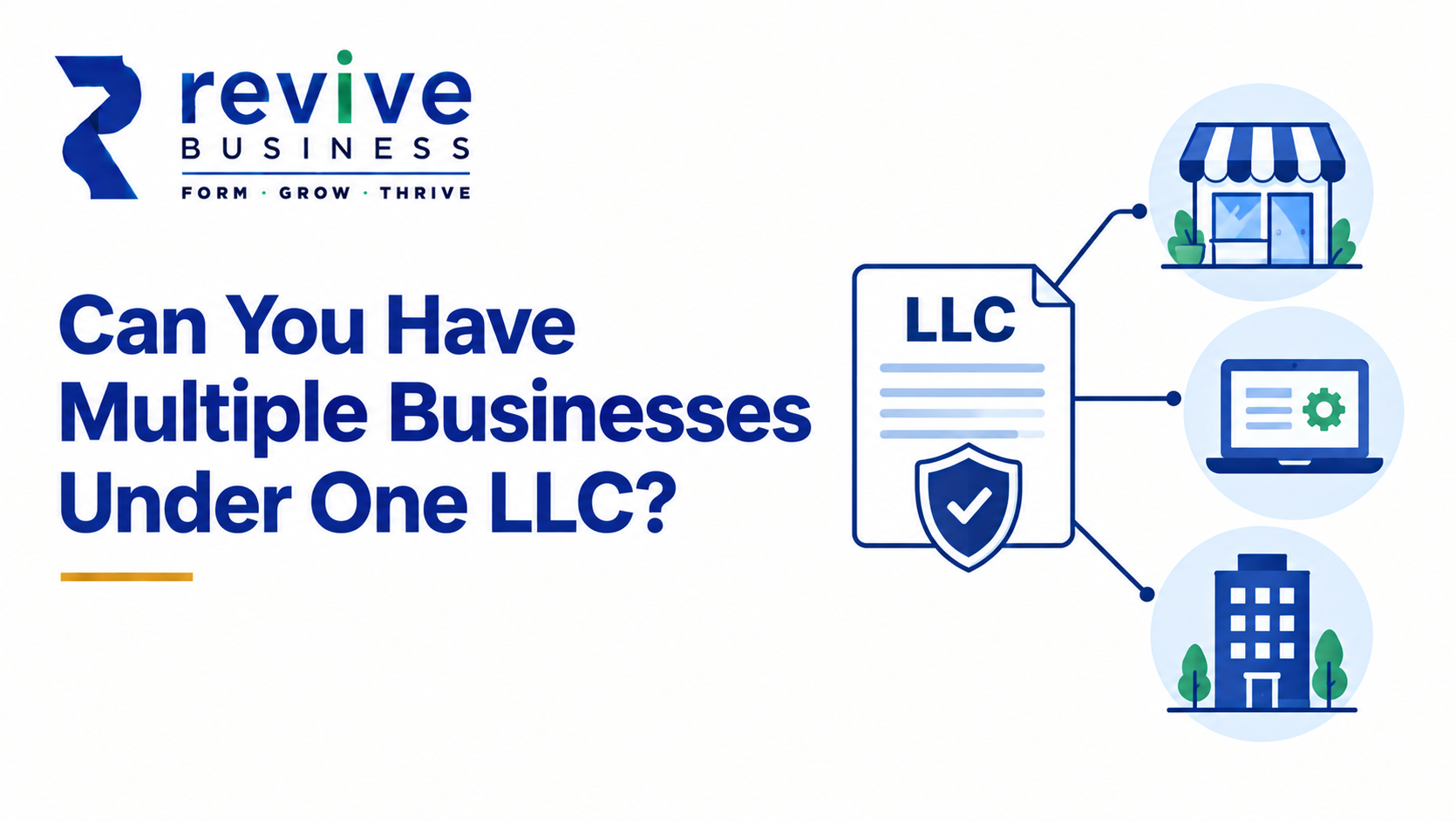
Yes. There is no legal limit on how many separate business activities a single LLC can operate. You can sell handmade furniture, run a consulting practice, and operate an e-commerce store all under one entity if you want to.
The more useful question is whether you should, and that depends almost entirely on one thing: what happens to your other businesses when one of them gets sued. Everything else in this decision, the cost savings, the admin simplicity, the branding flexibility, is secondary to that single risk question.
This guide covers the three structures available, how each handles that risk, and a practical way to decide which one fits your situation.
The Tradeoff That Drives This Entire Decision
Before looking at structures, understand what you are actually trading.
One LLC covering several businesses means one set of formation fees, one annual report, one registered agent, one EIN, and one tax return. That is genuinely cheaper and simpler. It also means one liability pool. Every asset in that LLC backs every obligation of that LLC, regardless of which business line created the obligation.
Put concretely: if your consulting business gets sued and loses a $200,000 judgment, the inventory, equipment, cash, and receivables sitting in your e-commerce business are available to satisfy it. The two operations feel separate to you. Legally they are the same pocket.
Separate LLCs reverse that. Each business carries its own formation costs, annual reports, registered agent fees, and tax filings, but a judgment against one generally cannot reach the assets of another. You are paying in money and administration for a wall between your ventures.
Everything below is a variation on where you place that wall and what it costs you.
Option One: One LLC With Multiple DBAs
This is the simplest and cheapest approach and it is where most entrepreneurs start. You keep one LLC and register a trade name, called a DBA or fictitious name, for each business you want to operate under a distinct public identity.
A DBA is purely a naming registration. It lets Smith Holdings LLC market itself as Coastal Candle Co. and as Bright Path Consulting without forming new entities. Customers see two brands. The state sees one company.
What this gives you is low cost and low admin. Most states charge somewhere between $10 and $100 per DBA registration, and there is generally no limit on how many you can file. You keep one EIN, one bank account if you want, one annual report, and one tax return covering all the activity.
What it does not give you is any liability separation whatsoever. This is the point most articles state and then move past too quickly. A DBA creates no legal entity and no protective wall. Your personal assets remain protected by the LLC itself, but the businesses inside the LLC have zero protection from each other. A claim against one brand is a claim against everything the LLC owns.
DBAs make sense when your businesses are low risk, closely related, small in scale, or still being tested. An early stage founder running three e-commerce storefronts selling different product categories is a textbook fit. A founder running a consulting practice alongside a business that owns a delivery vehicle is not.
Option Two: A Separate LLC for Each Business
The opposite end of the spectrum. Each business becomes its own legal entity with its own formation filing, its own EIN, its own bank account, its own records, and its own liability shield.
Most states place no limit on how many LLCs one person can form. The constraint is cost and attention, not law.
The advantage is clean risk isolation. A lawsuit against one business is contained within that business. It also makes each venture independently sellable, which matters more than people expect. Selling a business line that exists only as a DBA inside a larger LLC means carving out assets, contracts, and customer relationships from a shared entity. Selling an LLC means transferring membership interests. The second is dramatically simpler and buyers pay for that simplicity.
The cost is multiplication. Three LLCs means three sets of formation fees, three annual reports, three registered agent fees, three EINs, three bank accounts, and three tax returns every year. In a state like California with an $800 annual minimum franchise tax per entity, three LLCs cost $2,400 a year before you have done anything. In Tennessee with a $300 minimum annual report per entity, it is $900. The structure that looks obviously safer on paper gets expensive fast depending on where you are.
Option Three: A Holding Company With Subsidiary LLCs
The structure serious multi-business owners eventually move toward. A parent LLC owns the other LLCs as subsidiaries. The parent typically does not operate anything itself. Its job is ownership and asset holding.
Each operating subsidiary keeps its own liability protection, so risk stays contained at the subsidiary level. Meanwhile the parent can hold valuable assets such as real estate, equipment, or intellectual property and license them to the subsidiaries. That keeps the assets furthest from the operations most likely to generate lawsuits.
It also gives you a single point of control and cleaner reporting across the group, which becomes genuinely valuable once there are more than two or three ventures to track.
The cost is complexity. You still pay entity costs for every LLC in the group plus the parent. You need properly drafted operating agreements at both levels, documented intercompany agreements for anything the parent licenses or leases to the subsidiaries, and disciplined separation of books and accounts. Done casually, the structure provides less protection than the fees suggest.
A Fourth Option Worth Knowing About: The Series LLC
A series LLC is one legal entity that can create internal divisions, called series, each holding its own assets and, in theory, its own liability shield. It sits somewhere between the DBA approach and separate LLCs.
The appeal is obvious: separation resembling multiple LLCs with one filing. Delaware introduced the structure in 1996 and roughly a dozen or so states now permit it, including Illinois, Texas, Nevada, and Wisconsin.
Two cautions are worth stating plainly. First, most states do not offer series LLCs, and if you operate in a state that does not recognise them, the separation between your series may not be respected there. Florida, for example, does not allow series LLCs to be formed in state. Second, the liability separation between series has far less courtroom history behind it than the separation between distinct LLCs. Separate entities are a settled concept. Series separation is comparatively untested, and that uncertainty is the actual price of the convenience.
Series LLCs suit real estate investors holding multiple properties in a permitting state. For most other multi-business owners, separate LLCs or a holding company structure is the more predictable choice.
How to Decide: Four Questions
Instead of comparing structures abstractly, answer these about your actual situation.
Does one business carry noticeably more risk than the others? Anything involving physical premises open to the public, vehicles, contractors, food, children, health, or construction carries risk that the others should not be exposed to. If one venture is materially riskier, isolate it in its own entity even if everything else shares one.
Does one business hold most of the value? If a single venture holds the inventory, the equipment, the property, or the cash while another generates the legal exposure, keeping them in the same LLC means the valuable one is collateral for the risky one. Separate them.
Do you plan to sell any of them independently? If yes, that business belongs in its own entity from the start. Restructuring later is possible but usually involves transferring assets, renegotiating contracts, and potential tax consequences at exactly the moment you are trying to close a deal.
What does an extra entity cost in your state? This is the practical counterweight. In a state with a $50 filing fee and a $25 annual report, adding entities is cheap insurance. In California at $800 per year per entity regardless of profit, the calculation is very different and consolidating lower risk ventures under one LLC with DBAs becomes far more defensible.
How Taxes Work With Multiple Businesses
If you run several businesses as DBAs under one LLC, they are one taxpayer. One EIN covers all of them because they are the same legal entity. Income and expenses from every business line combine into a single return, which means a loss in one venture offsets profit in another automatically. For owners running a profitable business alongside a newer one still losing money, that is a genuine and often overlooked advantage of the single entity approach.
If you run separate LLCs, each is its own taxpayer with its own EIN and its own return. Losses in one do not automatically offset profits in another at the entity level, though as the owner you may still see offsetting effects on your personal return depending on how the entities are taxed and whether passive activity rules apply.
One practical note regardless of structure: keep separate books for each business line even when they share an entity. Combined bookkeeping makes it impossible to tell which venture is actually profitable, and if you later want to sell or spin off a business line, reconstructing its financial history from commingled records is painful and reduces what a buyer will pay.
Where Multi-Business Owners Actually Get Into Trouble
The owners who run into problems are rarely the ones who picked the wrong structure. They are the ones who picked a reasonable structure and then stopped maintaining it.
The common failures look like this. Running several LLCs out of one bank account, which undermines the separation you paid for. Signing contracts in the wrong entity name, so the liability lands somewhere you did not intend. Skipping DBA registrations and operating under names the state has no record of. Letting annual reports lapse on the entity you consider less important. Using a generic operating agreement template for a holding company structure, where the agreements are the architecture holding the separation together.
Each of these gives a plaintiff an argument that your entities are not genuinely separate and should be treated as one. That argument, if it succeeds, collapses exactly the protection the structure was built to provide.
Setting the Structure Up Correctly
The right structure is rarely permanent. Most owners start with one LLC and DBAs because that matches the risk and the budget at the time, then separate a venture into its own entity once it grows, takes on real liability exposure, or becomes something worth selling.
What matters is that the structure matches the risk at the moment rather than the risk when you set it up three years ago. Reviewing it when you add a business line, take on premises, hire employees, or start holding meaningful assets is the habit that prevents most problems here.
Whether you are adding a DBA to an existing company or standing up a second entity, professional LLC formation services can handle the filings and, more importantly, the operating agreements that make a multi-entity structure hold up. The paperwork is the easy part. The documentation that proves your businesses are genuinely separate is what does the actual work if it is ever challenged.
Frequently Asked Questions
How many DBAs can one LLC have?
Most states set no limit. Each DBA is registered and paid for separately, typically between $10 and $100 depending on the state, and some require renewal every few years. Florida, for example, allows unlimited DBAs under one LLC with each filed individually.
Do I need a separate EIN for each business under one LLC?
No. Businesses operating as DBAs under a single LLC share that LLC's EIN because they are the same legal entity. Separate LLCs each need their own EIN.
Does a DBA protect one business from another business's lawsuit?
No. A DBA is a name registration, not a legal entity. All businesses operating under one LLC share a single liability pool. Your personal assets stay protected by the LLC, but the business lines have no protection from each other.
Can I open separate bank accounts for each DBA?
Yes, and most banks will allow it using your single LLC EIN and the DBA registration paperwork. It does not create legal separation, but it makes bookkeeping and profitability tracking for each business far cleaner.
Can I move a business out of my LLC into its own entity later?
Yes, though it takes work. You form the new LLC, transfer the relevant assets and contracts, update customer and vendor records, and handle any tax consequences of the transfer. It is considerably easier if that business has kept separate books and its own bank account from the start.
Is a series LLC available in every state?
No. Only around a dozen states permit them, including Delaware, Illinois, Texas, Nevada, and Wisconsin. If you operate in a state that does not recognise the structure, the separation between your series may not hold there, which is the main practical limitation.
The Short Version
You can absolutely run multiple businesses under one LLC. Whether you should comes down to how much risk one venture creates for the others and what an additional entity costs where you operate. Low risk, closely related, early stage ventures usually work fine under one LLC with DBAs. Anything carrying real liability, holding significant assets, or heading toward a sale generally deserves its own entity.
If you are weighing this decision or already running several ventures under a structure you are not sure fits anymore, the team at Revive Business can help you map the right setup and handle the filings to get there.