How Do I Remove a Member from My LLC?
Learn how to remove a member from your LLC, including buyout rules, state law, IRS Form 8822-B, and what happens when a member refuses to leave.
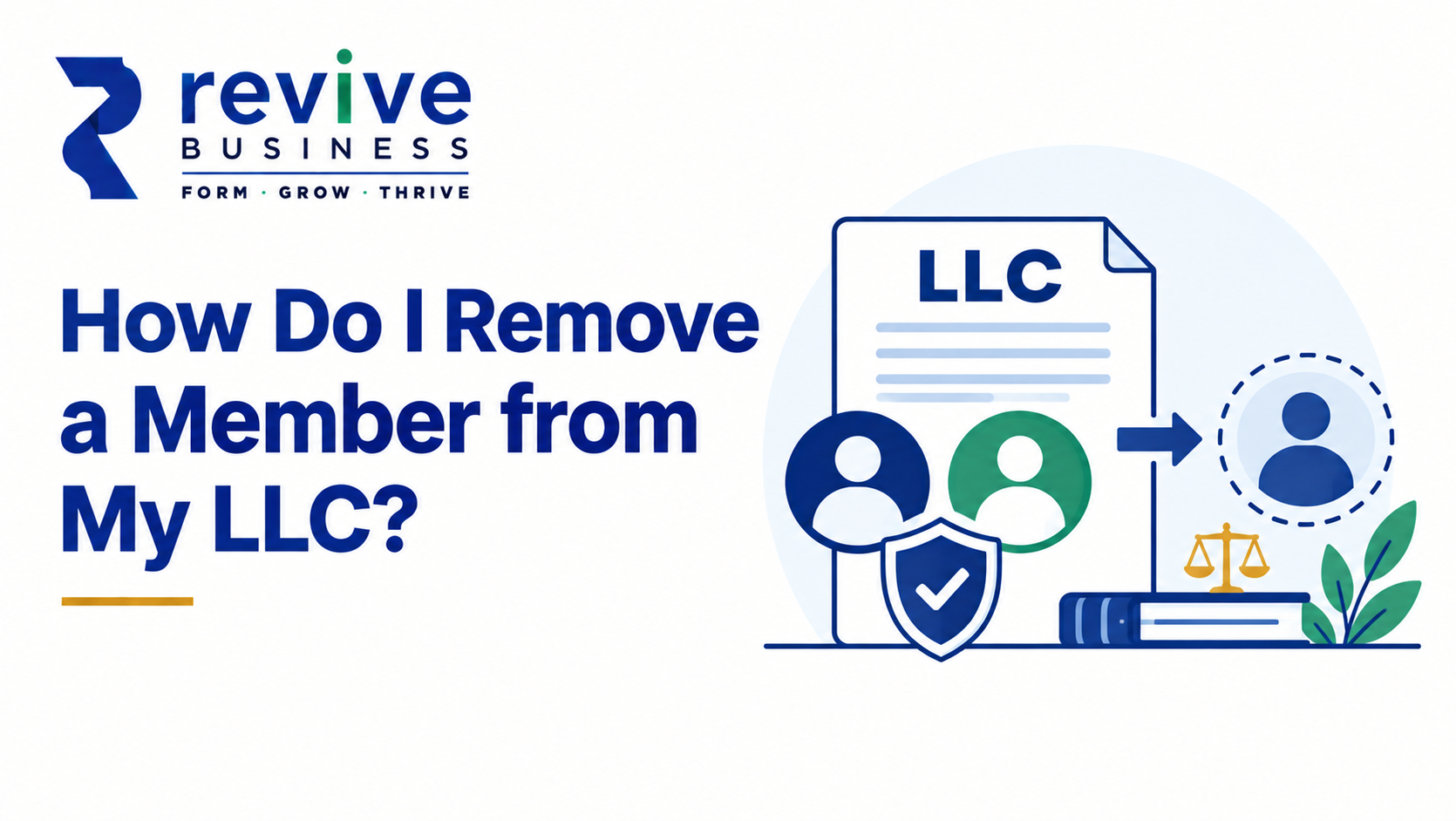
Removing a member from an LLC follows one of three paths. Your operating agreement lays out a removal procedure and you follow it. The member agrees to leave and you negotiate a buyout. Or the member refuses to go and the remaining members petition a court to force the removal.
Which path applies to you depends almost entirely on what your operating agreement says and, if it says nothing, what your state law provides. The difference between those paths is significant. A removal handled under a well drafted operating agreement can be completed in weeks. A contested removal that ends up in court can take months, cost tens of thousands of dollars in legal fees, and in some states result in the dissolution of the entire business rather than the removal of one person.
This guide walks through each path, explains what most business owners get wrong about the process, and covers the steps that have to happen after the removal is agreed so the change actually holds up legally.
Start With Your Operating Agreement
Your operating agreement is the single most important document in any member removal. It functions as the internal constitution of your LLC and its terms override default state law on nearly every point that matters here.
Before doing anything else, locate the agreement and read the sections covering member withdrawal, resignation, expulsion, and transfer of membership interests. You are looking for four specific things: whether a removal procedure exists at all, what vote threshold is required to remove someone, whether a notice period applies, and how the departing member's interest gets valued and paid out.
If your agreement addresses removal, follow those terms exactly. Courts consistently enforce operating agreement provisions on this issue, and deviating from your own documented procedure is one of the fastest ways to give a departing member grounds to challenge the removal later.
The harder scenario is the common one. Most operating agreements are silent on involuntary removal because few founders sit down at formation and plan for the possibility that one of them will need to be forced out. If yours has no removal provision, your options narrow considerably and state law takes over.
Path One: The Member Agrees to Leave
A voluntary exit is faster, cheaper, and far less damaging to the business than any forced removal. Even when relationships have deteriorated badly, it is almost always worth attempting a negotiated departure before considering litigation.
A voluntary removal generally involves a written resignation or withdrawal notice from the departing member, a negotiated buyout agreement setting the price and payment terms, a written consent or resolution signed by the remaining members approving the departure, and an amended operating agreement reflecting the new ownership percentages.
Document every step. Retain the resignation letter, the signed buyout agreement, the member resolution, the valuation used to set the price, and the amended operating agreement in your company records. If the departing member later disputes the terms, those documents are what protect the remaining members.
Path Two: Removal by Member Vote
If your operating agreement authorizes removal by vote, this is the cleanest route for an involuntary departure. The agreement will specify the threshold, which is typically either a majority of remaining membership interests or unanimous consent of the other members.
Follow the procedure precisely. Give whatever notice the agreement requires, hold the vote in the manner the agreement specifies, and record the outcome in a written resolution signed by the members who voted. Skipping formalities because everyone already knows the outcome is a mistake that creates openings for a later challenge.
One point that catches owners off guard is what happens without an operating agreement provision. In states that have adopted the Revised Uniform Limited Liability Company Act, members generally cannot simply vote out another member at will. There is no default majority rules expulsion. Roughly 21 to 26 states plus the District of Columbia follow some version of RULLCA, including California, Florida, and New Jersey. In those states, absent an operating agreement provision, removal usually requires a court petition rather than an internal vote.
Path Three: Judicial Dissociation
When the operating agreement is silent and the member refuses to leave voluntarily, the remaining members must ask a court to order the dissociation. This is the most expensive and least predictable path and it should genuinely be treated as a last resort.
Under the RULLCA framework, a court can expel a member on the LLC's application when that member has engaged in wrongful conduct that materially and adversely affected the company's activities, has willfully or persistently breached the operating agreement or their duties to the company, or has behaved in a way that makes it not reasonably practicable to carry on the business with that person involved.
That last standard is where most petitions succeed or fail, and courts interpret it narrowly. Personality clashes, disagreements about strategy, and general frustration with a co-owner do not meet the bar. Courts want evidence of conduct that genuinely damaged the business or made continued joint operation impossible.
Judicial dissociation means litigation with everything that implies. Expect discovery, evidence presentation, and a wait of many months for a ruling. In some states the court may decide that dissolving the LLC entirely is the more appropriate remedy rather than expelling one member, which means the remaining members would need to wind up the business and form a new entity to continue operating. That outcome is precisely why a well drafted operating agreement matters so much before any conflict arises.
Valuing and Paying the Buyout
The buyout is usually the most consequential part of any member removal. Getting the price wrong or failing to document the terms properly creates legal exposure that can follow the LLC for years.
If the operating agreement specifies a valuation method, that method controls. Common approaches include a multiple of earnings, a formula based on book value, or an agreed price that the members update periodically. When the agreement is silent, the remaining members and the departing member have to agree on a price through negotiation.
In practice, most buyouts without a pre-agreed formula involve hiring an independent business appraiser. A formal valuation by a certified appraiser typically costs several thousand dollars, but it provides an objective basis both sides can point to, which is often what allows a contested buyout to settle without litigation. The appraiser examines financial statements, assets, liabilities, earnings history, and market conditions to arrive at fair market value for the departing member's interest.
Payment terms matter as much as the price. Many buyouts are structured as installment payments over a period of years rather than a lump sum, because few small LLCs have the cash on hand to buy out a significant ownership stake immediately. Whatever the structure, put it in a signed buyout agreement that specifies the amount, the schedule, any interest, and what happens if a payment is missed.
The Detail Most LLC Owners Miss: Removal Does Not End the Financial Interest
This is the single most commonly misunderstood aspect of member removal and it surprises owners repeatedly.
Once a member is dissociated, whether voluntarily, by vote, or by court order, their management rights end immediately. They lose the ability to participate in decisions, vote on company matters, or act on behalf of the LLC. That part works the way most people expect.
What does not happen automatically is the termination of their financial interest. Under the RULLCA framework, a dissociated member retains a transferable economic interest, meaning they still have the right to receive distributions until that interest is actually purchased or the company dissolves. In practical terms, you can remove someone from management and still owe them a share of profits.
This is why the buyout is not an optional add-on to the removal process. Removal without a completed buyout leaves the LLC with a former member who has no voice in the business but continues to hold an economic claim against it. That is rarely the outcome the remaining members intended.
What You Have to Do After the Removal Is Agreed
Agreeing on the removal is only part of the work. Several filings and updates have to follow or the change will not be properly reflected in the records that matter.
Amend the Operating Agreement
Update the agreement to reflect the new ownership percentages, revised voting rights, and adjusted profit and loss allocations among the remaining members. This document governs the business going forward and leaving it outdated creates confusion in every subsequent decision.
File a State Amendment If Required
Whether you need to file with the state depends on whether your Articles of Organization list members by name. Many states do not require member names in formation documents, in which case no amendment is needed. States that do list members generally require Articles of Amendment to reflect the change. Some states also require the update in the next annual or biennial report, and filing timelines vary with penalties possible for delays. Check your Secretary of State requirements for the specific form and fee.
File IRS Form 8822-B If the Responsible Party Changed
If the departing member was listed as the responsible party on the LLC's EIN application, you must notify the IRS by filing Form 8822-B within 60 days of the change. This is a commonly missed step because it does not feel connected to the removal process, but the IRS requires the responsible party on file to be a person with actual control over the entity.
Watch the Tax Classification Trigger
If removing a member takes your LLC from two members down to one, the federal tax classification changes. A multi-member LLC is taxed as a partnership by default. A single-member LLC is treated as a disregarded entity. That shift ends the partnership tax year, requires a final Form 1065 partnership return, and changes how the remaining owner reports business income going forward. This is a genuine tax event, not a paperwork formality, and it is worth discussing with a tax professional before the removal is finalised rather than after.
Update Banks, Registered Agent Records, and Third Parties
Notify your business bank to remove the departing member as an authorised signatory. Update your registered agent records if that person held the role. Revoke system access, cancel accounts opened in their name, and change credentials they had access to. Notify any lenders, landlords, or major vendors where the departing member was the named contact or a guarantor.
Preventing the Problem in the First Place
Almost every difficult member removal traces back to the same root cause: an operating agreement that either did not exist or did not address what happens when an owner needs to leave.
An operating agreement that addresses removal properly will specify the grounds for expulsion, the vote threshold required, the notice period, a valuation formula or method for setting the buyout price, and payment terms for the buyout. Those five provisions are the difference between a removal that takes weeks and one that takes a year and a courtroom.
For multi-member LLCs being formed now, building these provisions into the agreement at formation costs very little and is dramatically cheaper than negotiating them later under pressure. Professional LLC formation services typically include operating agreement preparation as part of the formation package, which gives multi-member businesses a governing document that anticipates member departures rather than one that goes silent at the moment it is needed most.
If your LLC already exists with a thin or missing operating agreement, amending it while all members are still on good terms is far easier than drafting removal terms once a conflict has already started.
Frequently Asked Questions
Can I remove a member from my LLC without their consent?
It depends on your operating agreement and your state. If the agreement contains an expulsion provision, you follow that procedure. If it does not, states following the RULLCA framework generally do not allow a simple majority vote to expel a member, and removal requires petitioning a court for judicial dissociation.
Do I have to buy out a removed member?
In nearly all cases yes. Removal ends management rights but a dissociated member generally retains an economic interest and a right to distributions until that interest is purchased. Removing someone without completing a buyout leaves them with an ongoing financial claim against the business.
How is the buyout price determined?
The operating agreement controls if it specifies a valuation method. Without one, the parties negotiate, and most contested buyouts involve an independent business appraiser whose formal valuation typically costs several thousand dollars but gives both sides an objective number to work from.
Do I need to notify the IRS when a member leaves?
You must file Form 8822-B within 60 days if the departing member was the LLC's responsible party on the EIN application. Separately, if the removal reduces the LLC from multiple members to one, the tax classification changes and a final partnership return is required.
Do I have to file anything with the state?
Only if your Articles of Organization name members or your state requires membership updates in annual filings. Many states do not list members in formation documents, in which case no state amendment is needed. Check your Secretary of State requirements to confirm.
What if there is no operating agreement at all?
Your state LLC statute fills the gap, and default statutes are generally far less favourable to the remaining members than a custom agreement would be. Without a removal provision, a negotiated voluntary exit is usually the only practical option short of litigation.
Can removing a member dissolve the LLC?
It can. In some states a court weighing a judicial dissociation petition may decide dissolution is the more appropriate remedy, particularly where the LLC has only two members and the relationship has broken down entirely. The remaining owners would then wind up the business and form a new entity to continue operating.
Getting the Removal Right
Member removals go wrong in predictable ways. The operating agreement gets ignored, the buyout is agreed verbally and never documented, the state filing is skipped, the IRS notification is forgotten, or the tax classification change is discovered months later at filing time.
Every one of those is avoidable with a clear process and proper documentation at each step. If you are working through a member removal or forming a multi-member LLC and want the governing documents to actually cover this situation, the team at Revive Business can help you get the structure and paperwork right from the start.