Does Texas Have a State Income Tax? What Residents and Business Owners Need to Know in 2026
Texas has no state income tax on wages or business profits. Learn what taxes Texas does collect, how it affects LLC owners, and what to plan for in 2026.
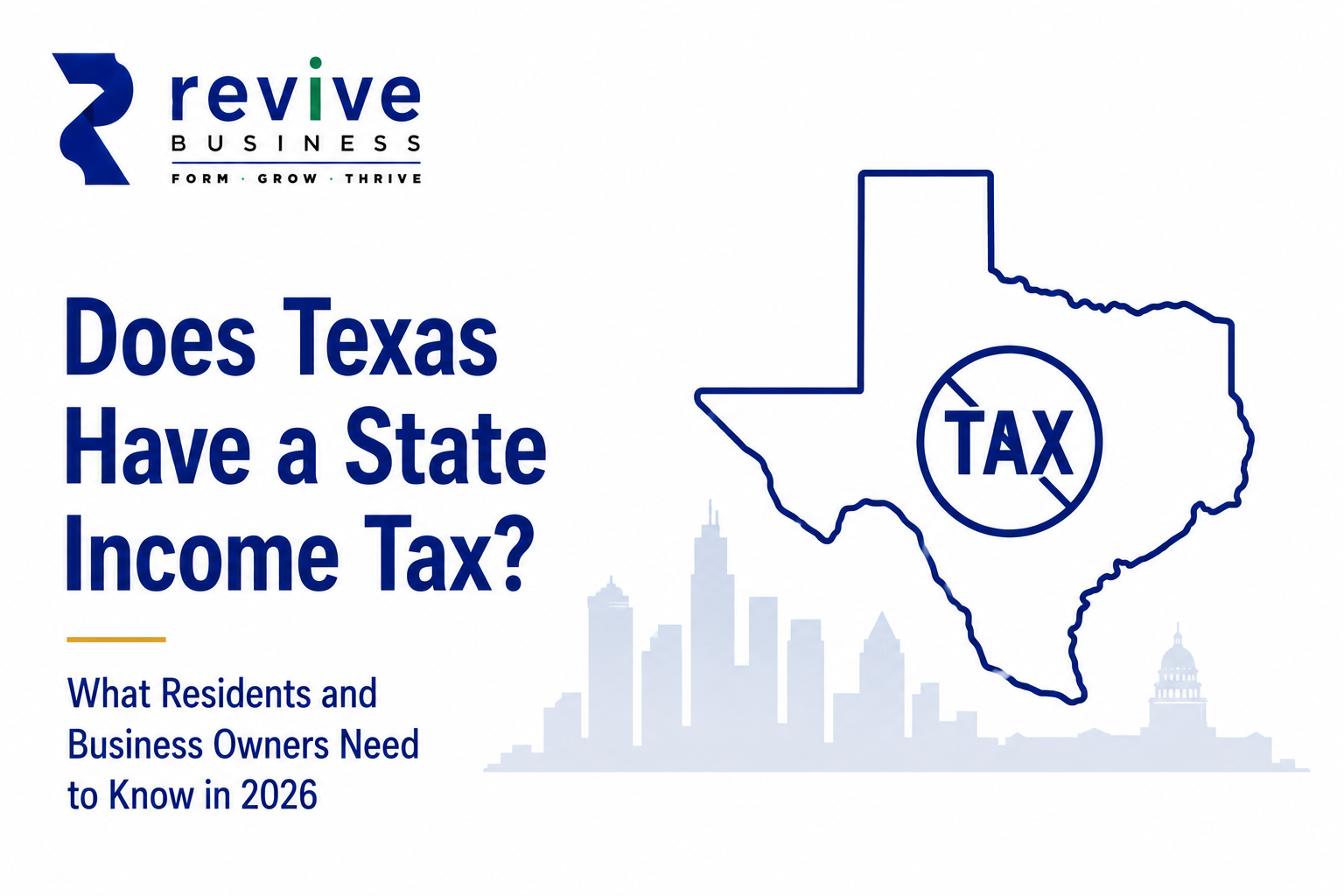
Texas has no state income tax. It does not tax wages, salaries, business profits, retirement income, capital gains, or investment returns at the state level. Texas is one of nine states in the country with no broad-based individual income tax, and the Texas Constitution makes it exceptionally difficult to introduce one without a statewide voter referendum. For residents, retirees, and business owners, this is a genuinely significant financial advantage that compounds over time.
But Texas is not a zero-tax state. It funds one of the largest state governments in the country through alternative mechanisms, some of which carry rates that are among the highest in the nation. Understanding the full Texas tax picture matters for anyone making a financial or business decision based on the no-income-tax headline, because the absence of an income tax does not mean an absence of significant tax obligations.
This guide covers everything residents and business owners need to know about Texas taxes in 2026, including what the state does and does not tax, how LLC owners are specifically affected, and how the Texas tax environment compares to other no-income-tax states.
Texas Has Never Had a State Income Tax and Here Is Why That Is Unlikely to Change
Unlike Tennessee, which eliminated its Hall Income Tax on investment income in 2022, Texas has never imposed a personal income tax of any kind throughout its history as a state. The Texas Constitution was amended in 1993 to add Article VIII, Section 24, which prohibits the legislature from enacting a personal income tax without first submitting it to voters in a statewide referendum. Even if a tax were approved by voters, two-thirds of any proceeds would be required to reduce school property taxes and the remaining third could only be used for education.
This constitutional protection was further reinforced when Texas voters approved Proposition 4 in November 2019 by a margin of approximately 74% to 26%, making it even harder for any future legislature to introduce an income tax. The amendment required a two-thirds vote in both chambers of the legislature just to place the question on the ballot, and then a majority of voters to approve it. For long-term financial planning purposes, Texas's no-income-tax status is as constitutionally protected as any tax policy in the United States.
The practical implication is that a Texas resident earning income from wages, business operations, investments, retirement accounts, or any other source pays zero state income tax on those earnings. Every dollar that would otherwise go to a state income tax stays in the taxpayer's pocket. For high earners and active business owners, this distinction is one of the primary financial reasons Texas has experienced sustained population growth from high-tax states over the past decade.
What Texas Does Tax: The Full Picture Every Resident Needs to Know
Texas funds its government primarily through property taxes, sales taxes, and business taxes. These mechanisms collectively generate revenue at a scale that makes Texas one of the highest-taxed states on property ownership and consumption while being one of the lowest-taxed on income.
Property Tax
Texas has some of the highest effective property tax rates in the United States. The average effective property tax rate in Texas is approximately 1.6% to 1.8% of assessed market value, which is more than double the national average of around 0.9%. In many Texas counties, particularly in the Dallas-Fort Worth metroplex, Austin area, Houston area, and San Antonio, effective rates regularly exceed 2% of market value on residential properties.
The reason is structural. Because Texas collects no income tax, local governments and school districts rely heavily on property tax revenue to fund public services. School district property taxes alone often represent the largest single component of a Texas homeowner's annual tax bill. A Texas homeowner with a $400,000 home in the Austin area can reasonably expect to pay $7,000 to $9,000 per year in property taxes, which partially offsets the income tax savings that make Texas attractive to high earners.
Texas does provide a homestead exemption that reduces the taxable assessed value of a primary residence by $100,000 for school district taxes, which was increased from $40,000 following voter approval in 2023. Homeowners over 65 and disabled homeowners receive additional exemptions that cap school tax increases and provide further relief.
Sales Tax
Texas imposes a state sales tax of 6.25% on the sale of most tangible personal property and many services. Local governments in Texas, including cities, counties, and special districts, can add up to 2% in local sales taxes, bringing the maximum combined rate to 8.25% in most major Texas cities. Dallas, Houston, San Antonio, and Austin all have combined rates at or near the 8.25% maximum.
Texas is notable for taxing a broad range of services that many states exempt. Telecommunications services, data processing, information services, amusement and recreation services, personal services, and repair and maintenance services are all subject to Texas sales tax in ways that catch many service-based businesses off guard. Texas also taxes internet access services and cloud computing services in certain configurations, which has become increasingly relevant for technology businesses operating in the state.
Groceries and prescription drugs are exempt from Texas sales tax, as are most agricultural items and manufacturing inputs. Prepared food sold at restaurants is taxable at the full rate.
Franchise Tax
Texas imposes a franchise tax, officially called the Texas Franchise Tax or Margin Tax, on most businesses conducting operations in Texas. This is one of the most important Texas-specific taxes for business owners to understand because it applies to LLCs, corporations, partnerships, and most other business entities operating in the state. Unlike many state franchise taxes that apply only to corporations, Texas's version applies broadly.
The franchise tax is calculated on taxable margin, which is essentially revenue minus the greater of cost of goods sold, compensation, or 30% of revenue. The standard tax rate is 0.75% of taxable margin for most businesses and 0.375% for businesses primarily engaged in retail or wholesale trade. A reduced rate of 0.331% applies under the E-Z Computation method for businesses with total revenue of $20 million or less.
Businesses with total annual revenue of $2.47 million or less (the 2026 no-tax-due threshold, which adjusts annually for inflation) pay no franchise tax and file a simplified no-tax-due report. This threshold exempts the vast majority of small Texas businesses from any franchise tax liability while still requiring an annual filing. Businesses between the no-tax-due threshold and $20 million in revenue are eligible for the E-Z Computation method.
The franchise tax report is due May 15 each year for most businesses. Missing this deadline results in penalties starting at 5% of the tax due for filings up to 30 days late and increasing for continued non-compliance. Even businesses that owe no tax must file a no-tax-due report or face penalties.
What No State Income Tax Means for Texas Residents
For a Texas resident, every dollar of income from any source arrives without state income tax deducted. Wages and salary are received in full. Business distributions from an LLC or S corporation pass through without state tax. Capital gains from the sale of investments or real estate are not taxed at the state level. Retirement distributions from 401k accounts, IRAs, and pension plans are received without Texas state tax. Social Security income is not taxed by Texas. There is no category of income that Texas taxes at the state level.
The financial impact depends significantly on what state a resident is comparing Texas to. A high earner relocating from California, which has a top marginal state income tax rate of 13.3%, saves an enormous amount annually. A California resident earning $300,000 per year could save $25,000 to $35,000 in state income tax annually by relocating to Texas, a figure that dwarfs the difference in property tax rates between the two states for most income levels.
For someone relocating from a state with a moderate income tax of 4% to 5%, the savings are real but more modest. A household earning $120,000 saves approximately $4,800 to $6,000 per year in state income tax in Texas compared to a 4% to 5% state. The high Texas property tax rates partially offset this advantage for homeowners, but renters and business owners who do not own real property receive the full income tax benefit with minimal offset.
Retirees living on fixed income benefit from Texas's no-income-tax policy on all retirement income sources. Social Security, pension payments, IRA and 401k distributions, annuity income, and investment dividends and capital gains are all received free of Texas state tax. The primary downside for retirees is the property tax burden if they own a home, though the over-65 homestead exemption and school tax freeze provide meaningful relief.
How Texas Taxes Affect LLC Owners Specifically
For LLC owners operating in Texas, the tax environment is genuinely favorable on the income side but requires careful attention to the franchise tax and sales tax obligations that many new business owners overlook.
A Texas LLC with pass-through taxation pays no Texas state income tax on business profits distributed to members. Those profits flow to the member's personal return and are subject only to federal income tax and self-employment tax at the federal level. The absence of state income tax on pass-through income is one of the most significant practical advantages of operating an LLC in Texas compared to states with income taxes.
However, Texas LLC owners must file a franchise tax report annually regardless of whether they owe any tax. LLCs with total annual Texas revenue below $2.47 million file a no-tax-due report and pay nothing. LLCs above that threshold calculate their margin tax liability and file accordingly. The report is due May 15. Missing the filing even when no tax is owed results in penalties, which surprises many LLC owners who assume they have no Texas tax obligation when their revenue is below the threshold.
Texas LLCs that sell taxable goods or qualifying services must register for a Texas sales tax permit before making their first taxable sale. Texas's broad definition of taxable services means that many service-based LLCs that would not collect sales tax in other states find themselves with a Texas sales tax obligation. Technology consulting, data processing, information services, and telecommunications are all taxable in Texas in ways that differ from most other states. Verifying your specific service type against the Texas Comptroller's published taxable service categories before making your first sale is worth doing carefully.
Federal Income Tax Still Applies in Full to Texas Residents
Texas's no-income-tax policy applies exclusively at the state level. The federal income tax is unchanged for Texas residents and businesses. A Texas LLC owner earning $200,000 in pass-through business income pays federal income tax on that amount at exactly the same rates as an identical business owner in New York, Illinois, or California. The IRS treats all US taxpayers equally regardless of which state they live in.
Self-employment tax also applies in full. A Texas sole proprietor or single-member LLC owner pays 15.3% self-employment tax on net business income up to the Social Security wage base and 2.9% above that threshold. This federal obligation is not reduced in any way by Texas's no-income-tax status. For LLC owners at income levels where the S corporation tax election produces meaningful payroll tax savings, that strategy is just as relevant in Texas as in any other state.
Federal estate tax, federal capital gains tax, and federal corporate income tax for LLCs that have elected C corporation treatment all apply to Texas businesses and residents at standard federal rates. The state tax advantage is real and significant, but it is bounded entirely to the state level. Federal obligations remain unchanged.
Texas vs Other No-Income-Tax States: How It Compares
The nine states with no broad-based individual income tax are Alaska, Florida, Nevada, New Hampshire, South Dakota, Tennessee, Texas, Washington, and Wyoming. Each handles its absence of income tax differently and comes with different tradeoffs that matter depending on your specific situation.
Texas stands out from this group for its combination of size, economic diversity, and business infrastructure. It has the second-largest state economy in the country, a highly diverse industry base spanning technology, energy, healthcare, financial services, and manufacturing, and a business formation process that is relatively straightforward. The $300 filing fee for a Texas LLC Certificate of Formation is on the higher end nationally, and the annual franchise tax report requirement adds compliance complexity that states like Wyoming and Nevada do not impose on small businesses at similar revenue levels.
Wyoming offers stronger LLC privacy protections, lower formation fees at $100, and no franchise tax for most small businesses, which makes it attractive for holding company structures and asset protection strategies. Nevada has no income tax and strong privacy provisions but higher ongoing annual fees. Florida has no income tax and no franchise tax on LLCs, lower property taxes than Texas in most counties, and a cost of living that competes favorably in many markets.
For business owners who actually live and operate in Texas, comparing Texas to other no-income-tax states is largely academic. The income tax benefit only applies at the state of residence. A Texas resident who forms an LLC in Wyoming but lives and works in Texas gets the Wyoming formation advantages but pays no state income tax in either state regardless, because Texas does not tax their income and Wyoming has no residents to tax. The formation state choice matters for fees, privacy, and LLC statute quality, but it does not change the income tax picture for a Texas resident.
Frequently Asked Questions
Does Texas tax Social Security income?
No. Texas does not tax Social Security income, pension payments, retirement account distributions, investment income, capital gains, or any other form of income at the state level. All income of every type is received free of Texas state tax, making it one of the most favorable states in the country for retirement income planning.
Do Texas LLC owners pay any state tax on business profits?
Pass-through LLC profits are not subject to Texas state income tax. However, Texas LLC owners must file an annual franchise tax report regardless of revenue, and LLCs with total Texas revenue above $2.47 million may owe margin tax on their taxable revenue. LLCs below that threshold file a no-tax-due report and owe nothing. The franchise tax report is due May 15 each year.
Why are Texas property taxes so high if there is no income tax?
Texas relies on property taxes and sales taxes to fund government services and public education because it does not collect income tax revenue. Local school districts, counties, and cities all levy property taxes that collectively produce the revenue a state income tax would otherwise generate. The result is effective property tax rates that average 1.6% to 1.8% of market value, roughly double the national average. The homestead exemption of $100,000 on school district taxes reduces the burden for primary homeowners.
Can Texas ever introduce a state income tax?
Introducing a Texas state income tax would require a two-thirds vote in both chambers of the Texas legislature to place the measure on the ballot, followed by approval by a majority of Texas voters in a statewide referendum. In 2019, Texas voters reinforced this protection by approving Proposition 4 with approximately 74% of the vote. Given the constitutional barriers and the consistent voter opposition to an income tax, the long-term stability of Texas's no-income-tax status is among the strongest of any state.
What is the Texas franchise tax and do I have to pay it?
The Texas franchise tax is a margin tax applied to most businesses operating in Texas based on their taxable revenue minus certain deductions. LLCs with total Texas revenue below $2.47 million in 2026 owe no franchise tax but must file a no-tax-due report by May 15. LLCs above that threshold pay 0.75% of taxable margin for most business types or 0.375% for retail and wholesale businesses. Even if you owe nothing, filing the annual report is mandatory and missing it results in penalties.
Does moving to Texas eliminate my state income tax obligation?
If you establish genuine Texas residency, you eliminate your obligation to pay state income tax to Texas because Texas has none. However, if you previously lived in a state like California, New York, or Illinois, those states may attempt to claim you as a resident for part of the tax year in which you moved, and you may owe tax on income earned while you were still legally a resident of that state. Establishing a clean break of residency on a specific date and documenting it thoroughly is important in the year of relocation, particularly when moving from states known for aggressive residency audits.
Managing Your Texas Tax Obligations the Right Way
Texas's no-income-tax environment is one of the most financially significant state tax advantages available in the United States. For residents and business owners who take full advantage of it, the savings compound meaningfully over time. The taxes Texas does collect, particularly the property tax, franchise tax for businesses above the threshold, and sales tax on a broad range of goods and services, still require proper planning and compliance.
Federal tax obligations remain fully in effect regardless of Texas residency, and for LLC owners and self-employed individuals, federal income tax and self-employment tax planning are often where the largest optimization opportunities exist. Getting your federal returns filed accurately, capturing every available deduction, and planning around self-employment tax obligations is where the real financial work happens for most Texas business owners.
At Revive Business, our tax return filing services help Texas residents and business owners navigate their federal tax obligations accurately and efficiently, ensuring every legitimate deduction is captured, every filing deadline is met, and your overall tax position is as strong as your Texas residency deserves. Reach out to the team at Revive Business today and let us handle the tax side while you focus on what you do best.